
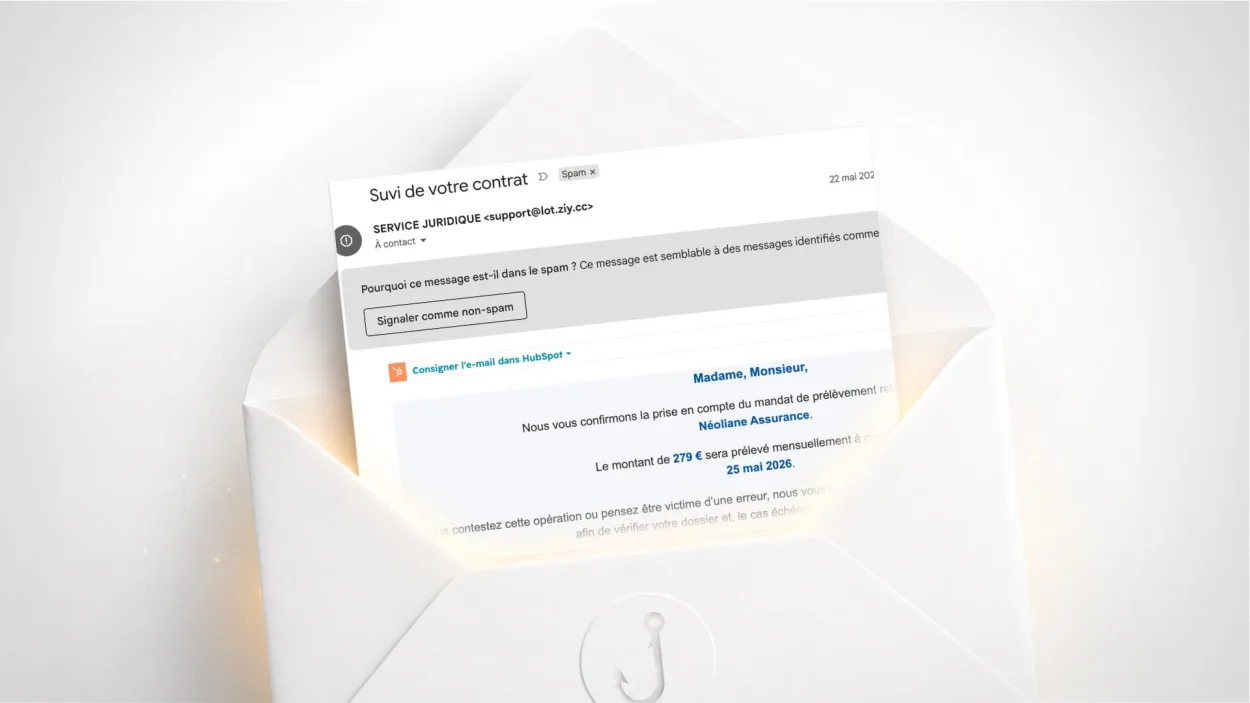
Have you received an email titled “Suivi de votre contrat” (“Follow-up on your contract”) signed “Service Juridique – Protection Contrôle Sécurité”, telling you that a monthly direct debit of €279 is about to be taken for a Néoliane Assurance contract, with a phone number to call if you want to dispute it? It is a scam. Do not call the number. Here is why, and what to do.
Is this Néoliane Assurance email a scam?
Yes. The sender is support@lot.ziy.cc, a .cc (Cocos Islands) domain with no connection to Néoliane or any legal department. SPF fails. The email was sent from an IP address located in Shanghai at 10:08 pm local time.
What sets this email apart from usual phishing: it contains no link and no button. Its only goal is to get you to call the number 01 89 62 99 57. This is known as vishing (voice phishing): a scam that starts by email but is completed over the phone.
How does this scam work?
The mechanism is simple and effective. The email creates immediate financial urgency: a €279 monthly direct debit is about to start in three days for a contract you never signed up for. The natural reaction is to call the number given to stop the debit.
On the other end of the line, a fake adviser claims to be from Néoliane’s “legal department” or “consumer protection department”. They will ask for information to “check your file” and “suspend the debit”: surname, first name, date of birth, social security number, bank details. In some variants of this scam, the fake adviser asks to take remote control of your computer to “cancel the mandate”.
None of this information stops anything. It is used to feed a database that is resold or to start further fraud.
Why is this scam particularly hard to detect?
The total absence of a clickable link is deliberate. Spam filters mainly analyse the URLs in emails, so an email without links gets through more easily. The spam score of this email is in fact negative despite SPF NONE, which confirms the technique works.
The email also shows several signs of apparent legitimacy: a precise amount (€279), a precise date (25 May 2026), a real company name (Néoliane Assurance exists) and a formal legal tone. The typo in the original subject line (“Suvi” instead of “Suivi”) is the only visible sign of carelessness.
Statistically, vishing is the type of scam with the highest average loss per victim, precisely because a human on the line can adapt their pitch in real time, answer objections and keep up the pressure far more effectively than an online form.
How to check whether you really have a Néoliane contract
If you have never taken out a contract with Néoliane Assurance, the answer is simple: this email does not concern you. Ignore it and delete it.
If in doubt, contact Néoliane directly using the official contact details on neoliane.fr, never the number given in the email. Also check your bank account: no Néoliane debit will appear if you have not signed a contract.
What to do if you called the number
If you called but did not share any information, the risk is limited. Block the number and do not call back.
If you shared personal information (name, address, date of birth, social security number), report it to the CNIL on cnil.fr and stay alert to possible identity theft attempts in the following weeks.
If you shared bank details or allowed remote access to your computer, act immediately: call your bank to block your card, change the passwords of your online accounts from another device, and file a complaint with the police. Also report the incident on Cybermalveillance.gouv.fr, which directs vishing victims to the right contacts in France.
To strengthen your overall protection, see our digital hygiene recommendations and our guide to protecting your personal data. If you think your mailbox has been compromised, see our guide on what to do if your email has been hacked.
Why is the Néoliane Assurance name used?
Néoliane is a real French health insurance company, which gives the message immediate credibility. Scammers choose real brands that are little known to the general public: established enough to seem legitimate, but obscure enough that most recipients cannot tell straight away whether they have a contract with them.
This type of campaign casts a wide net: by sending the same email to millions of people, attackers know that a fraction of recipients will be uncertain enough to call. It is the same logic as the other scams documented on safecode.fr, whether the fake Prime Video renewal, the fake unpaid rent notice or the fake bank alerts in the name of Société Générale or Nickel.
Néoliane direct debit email scam FAQ
Check the sender’s full address: a legitimate Néoliane email comes from an @neoliane.fr domain. A sender on an unknown domain like @lot.ziy.cc has no connection with the company. If you have never taken out a Néoliane contract, ignore the email. If in doubt, contact Néoliane directly via neoliane.fr, never through the number given in the email.
Vishing (voice phishing) is a scam that combines an alarming email with a fraudulent phone call. The email pushes the victim to call a number controlled by the scammers, who pose as customer service or a legal department to extract personal or banking information.
Contact your bank immediately to report a risk of fraudulent direct debit and ask for closer monitoring of your account. In France, any unauthorised SEPA direct debit can be disputed within 13 months. File a complaint with the police and report the incident on Cybermalveillance.gouv.fr.

Leave a Reply