
A critical flaw in BeyondTrust Remote Support, a remote assistance tool used by many IT teams, has been exploited since late August 2026, more than six weeks before the patch for self-hosted installations was published. Mandiant and Google suspect a China-linked espionage group. Here is what we know about CVE-2026-102764, who is affected and what to do.
What do we know about CVE-2026-102764?
On 15 October 2026, BeyondTrust published advisory BT26-05. The flaw is insufficient validation of message origin in an internal messaging component. A remote attacker can thereby perform file operations on the targeted appliance. It is rated 9.3 out of 10 (CVSS v4), needs neither authentication nor user interaction, and is classified CWE-290, according to BeyondTrust advisory BT26-05.
- Affected product: Remote Support, all versions up to and including 26.2.3.
- Fix: the BT26-05-RS patch covers versions 24.3.1 to 26.2.3. Below that, you must first upgrade to a newer version.
- SaaS customers: protected since 9 October 2026, no action needed.
- Self-hosted installations: the patch must be applied manually, unless automatic updates are on.
- Workaround: none is listed in the advisory; only the patch fixes the flaw.
Privileged Remote Access (PRA), the vendor’s other product, shares the affected code. BeyondTrust says it found no way to exploit it in PRA, but released a patch as a precaution and recommends self-hosted customers apply it, as reported by BleepingComputer.
The SaaS patch date varies by source: 8 October for BleepingComputer, 9 October for the vendor’s advisory and the Canadian Centre for Cyber Security. We use the vendor’s date.
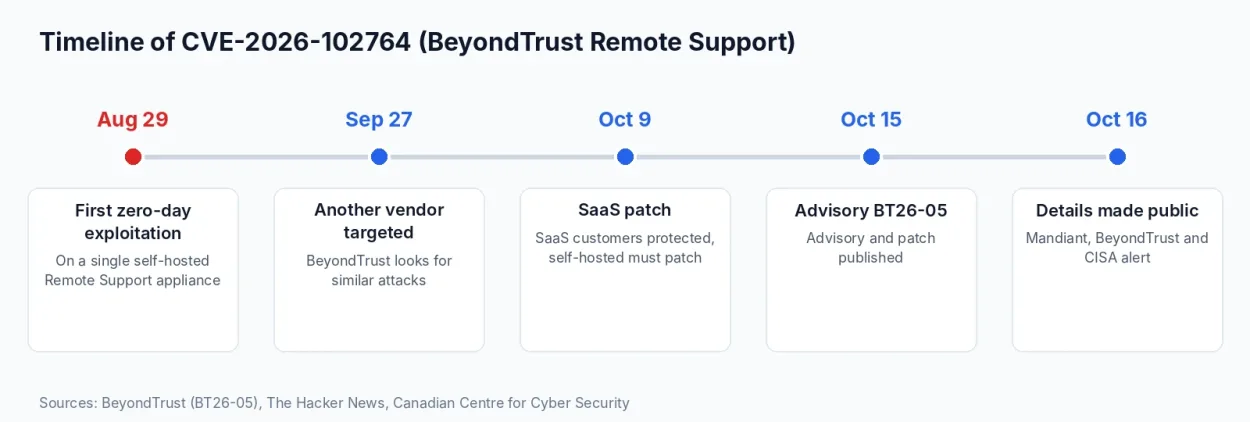
Exploited since 29 August
The flaw was exploited as a zero-day as early as 29 August 2026: Rapid7 counts two compromises on that date (one BeyondTrust-hosted instance and one self-hosted appliance), while The Hacker News mentions only a single self-hosted appliance. On 27 September, exploitation of another security product vendor became public, which led BeyondTrust to look for similar attacks. On 16 October, BeyondTrust and Mandiant published their findings, and CISA issued an alert and added the flaw to its Known Exploited Vulnerabilities (KEV) catalog, with a 19 October deadline for US federal agencies, as explained by The Hacker News. BleepingComputer does not mention CISA in its article.
Who is behind the attacks?
Mandiant and the Google Threat Intelligence Group suspect a China-linked espionage group, named Armory Castle (formerly UNC5221), which CrowdStrike calls Warp Panda. The group has been active since October 2023 and has already exploited zero-days in Citrix NetScaler and Ivanti Connect Secure. In earlier campaigns it targeted law firms, SaaS providers, outsourcers, technology companies and governments. No victim is named at this stage, and the article does not state the confidence level of the attribution.
What the attackers did after getting in
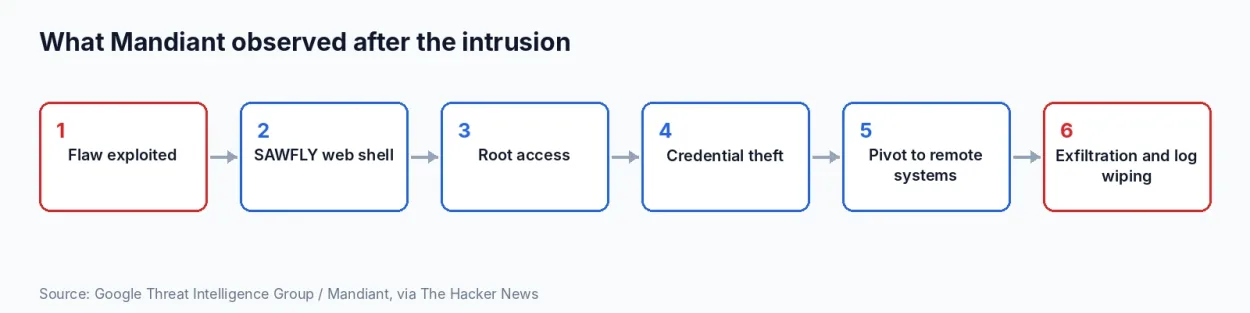
According to Mandiant, as reported by The Hacker News, the attackers:
- deployed SAWFLY, a lightweight PHP web shell offering remote access and encrypted communications;
- hid their origin using commercial VPN exit nodes and compromised home or small-office routers;
- gained root on the appliance, then tried to harvest the credentials stored in its secrets database;
- used compromised administrator credentials to open remote sessions to downstream systems, then exfiltrated internal documents;
- installed BARECLAW, a SOCKS5 proxy exposed to the Internet, and deleted system, web and application logs.
The key point: a remote support tool often holds privileged access to the whole estate. Compromising the appliance amounts to obtaining the keys to the machines it manages.
What to do if you use BeyondTrust Remote Support
- Identify your deployments and check, for each, whether it is SaaS or self-hosted, and its version.
- Apply the BT26-05-RS patch on self-hosted installations, after an upgrade if you are below version 24.3.1. Turn on automatic updates where appropriate.
- Treat as potentially compromised any Internet-reachable appliance that ran a vulnerable version during the exploitation window, until it has been reviewed (Mandiant’s recommendation).
- Take a forensic copy before remediating, hunt for unknown privileged sessions, then rebuild the appliance from a known-good state and patch it.
- Limit the appliance’s exposure to the services it needs.
- Rotate the credentials the appliance could hold or use. This last step is our own recommendation: it follows from the observed credential theft, but is not in the advisory.
Shadowserver tracks more than 1,400 BeyondTrust remote support instances exposed to the Internet, without saying how many are already patched, as written by BleepingComputer. Mandiant warns that large-scale exploitation attempts are possible after disclosure, as in this group’s earlier campaigns.
And if you are not directly affected?
If you don’t administer this product, there is nothing to do on your side. But if a company or provider you are a customer of uses Remote Support, its teams have fixes to apply. This case mostly reminds us that equipment exposed at the network edge (remote access, VPN, firewall) is a priority target for espionage groups, which attack these products repeatedly.
Sources: BeyondTrust, advisory BT26-05, The Hacker News, BleepingComputer and Canadian Centre for Cyber Security.
Frequently asked questions about the BeyondTrust flaw CVE-2026-102764
It is a remote assistance tool (formerly Bomgar) that lets IT teams take control of workstations and servers to fix them.
All Remote Support versions up to 26.2.3. The BT26-05-RS patch covers versions 24.3.1 to 26.2.3; below that, you must upgrade first.
No. SaaS customers have been protected since 9 October 2026, according to the vendor.
Yes, since 29 August 2026 according to The Hacker News. Mandiant suspects a China-linked espionage group, with no victim named.
Mandiant recommends assuming so for any Internet-reachable appliance on a vulnerable version during the exploitation window, until it has been reviewed.

Leave a Reply