

Freezers at grocery stores on US military bases failed in August 2026, and the Pentagon is now treating the incidents as a suspected cyberattack. US officials reportedly suspect an Iranian link, but nothing is confirmed. The failures echo the attack that made the fridges of hundreds of French supermarkets heat up in October, which we covered in our article on the supermarkets. Here is what we know, what rests on anonymous sources and what remains unknown.
What happened
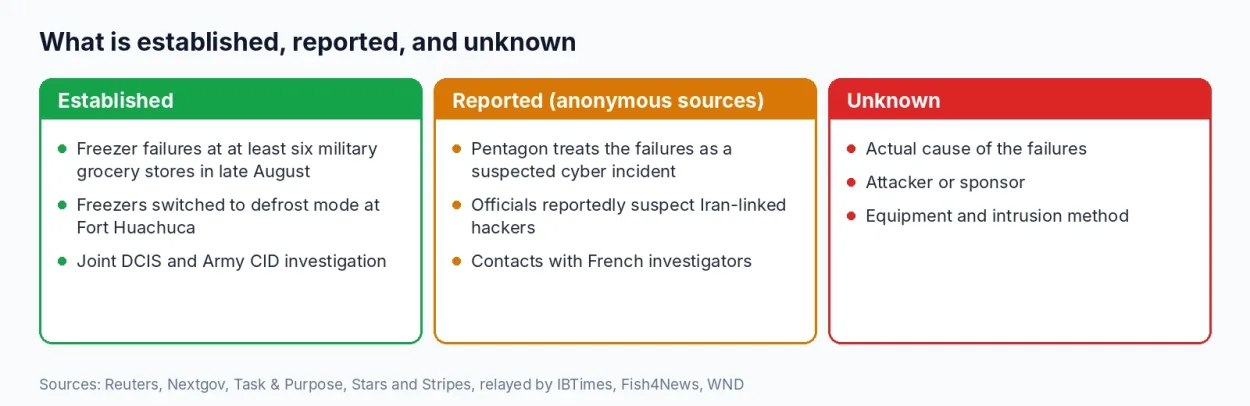
According to Reuters, whose reporting Militarnyi relayed, at least six military grocery stores, the “commissaries” where service members and their families shop, were hit. Some fridges shut off, others switched to defrost mode on their own, which raised temperatures and spoiled food. Reuters relies on four people familiar with the matter, who are not named.
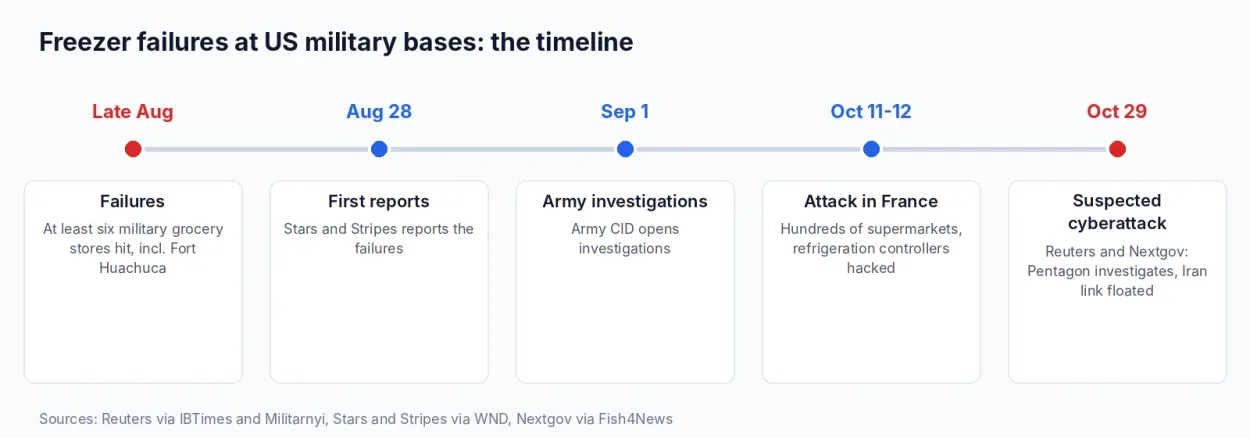
At Fort Huachuca in Arizona, the base said on Facebook that all freezers had gone into defrost mode and that all frozen food had been lost, as IBTimes reported. No frozen items were sold until further notice. In one case, temperatures were reportedly also raised overnight. The base’s notice did not mention a cyberattack.
According to WND, which draws on Reuters, the stores concerned are at Fort Huachuca, Fort Irwin, F.E. Warren AFB, Naval Station Newport, Columbus AFB and Travis AFB. Stars and Stripes reported the failures on August 28, and the Army Criminal Investigation Division (CID) investigations began on September 1. Losses amount to thousands of dollars: meat, dairy and frozen goods, with sales limited in some stores.
Who is investigating
The Pentagon confirmed that a Cyber Command unit is working closely with interagency partners and law enforcement, according to Reuters via Militarnyi. WND adds that the Defense Criminal Investigative Service (DCIS) leads a joint investigation and that the Army CID’s Cyber Field Office takes part. A department official said he was “aware of the speculation” about a cyber incident, without commenting on ongoing investigations.
US investigators also contacted their French counterparts, as Militarnyi wrote, to exchange information on a similar attack. According to Reuters, hackers remotely manipulated the temperature controls of more than 350 sites in France, a lower figure than some French estimates.
The Iran lead: a suspicion, not proof
Fish4News summarizes a Nextgov report from October 29: two anonymous sources say US officials suspect Iran-linked hackers. The Pentagon has confirmed neither that lead nor even that the failures come from a hack. According to the same account, no published expert report ties Iranian hackers to the failures, and no malware, compromised account or intrusion method has been made public. Nextgov does not name a specific group, and its conclusions could change.
As background, the same article recalls that a CISA and FBI warning, updated on July 22, described Iran-affiliated hackers targeting internet-connected industrial equipment. That documents activity, but not a link to the military freezers. Likewise, the French investigation does not attribute its attack to Iran. In its weekly roundup, This Week in Security mentions the US suspicion about Iran without adding further evidence.
A link with France?
Experts cited by Militarnyi blame outdated controllers, designed to run on their own but now connected to the Internet. The Global Food Safety Initiative (GFSI) calls for stronger security of refrigeration systems. On the hardware side, WND recalls that Danfoss controllers, often old and without security updates, were singled out in the French attack, and that Claroty had found flaws in them. However, it is not established that the military stores use Danfoss equipment, nor that there is a common cause. According to IBTimes, European Commissioner Christophe Hansen spoke of the “weaponization of food” about the French attack, but that proves nothing about the US case.
What is still unknown
- The real cause: the cyber nature of the failures is only a hypothesis, based on anonymous sources.
- The attacker or sponsor: none is identified, and the Iran lead is not publicly supported.
- The equipment and method: the controller models and the intrusion method are unknown.
- The link with France: the two cases look alike, with no proof of a common origin.
What this changes for refrigeration operators
This part is our analysis. Whether the link is confirmed or not, the lesson is the same as for the supermarkets: a refrigeration or heating controller exposed to the Internet, old and rarely updated, is an easy target, and one defrost setting is enough to destroy a stock. Priority measures are simple:
- Remove direct Internet exposure of administration interfaces and use a VPN for maintenance.
- Inventory the controllers and replace those whose manufacturer no longer publishes patches.
- Monitor critical settings (defrost cycles, temperature setpoints) with alerts independent of the controller.
- Plan a degraded mode: standalone temperature probes and a manual switchover procedure.
For the details of ANSSI and CERT-FR guidance on Danfoss, Copeland and Dixell equipment, see our article on the supermarket attack.
Frequently asked questions about the military freezer failures
In late August 2026, freezers at at least six military grocery stores failed or switched to defrost mode, causing food losses. The Pentagon is treating the failures as a suspected cyber incident.
That is not established. Two anonymous sources cited by Nextgov mention Iran-linked hackers, but the Pentagon has confirmed nothing and no technical evidence is public.
US investigators contacted their French counterparts, and the two cases look alike. No link is proven, and the French investigation does not attribute its attack to Iran.
Cyber Command coordinates with interagency partners, the DCIS leads a joint investigation and the Army CID takes part.
Take administration interfaces off the Internet, use a VPN, replace obsolete controllers and set up temperature alerts independent of the controller.
