
On November 1, 2026, a hacker put up for sale on a cybercriminal forum a file attributed to Groupe MPA, an online seller of license plates and stickers based in Marsannay-la-Côte, in France’s Côte-d’Or. The seller mentions about 1.7 million customers, with their contact details, orders and plates. The company has not confirmed the leak so far. Here is what is claimed, what remains to be verified and why the main risk is targeted phishing.
What is claimed
As Fuites Infos reported, an unidentified actor offered the data for sale on November 1, presenting it as coming from eleven sites. Named sites include mpadeco.com, mpa-pro.fr and plaque-immatriculation-auto.com. Cyberattaque.org attributes the sale to a hacker calling himself “ChimeraZ”, and adds autocollants-stickers.com, e-mmat.fr, lecoqfuneraire.fr and foreign shops to the list.
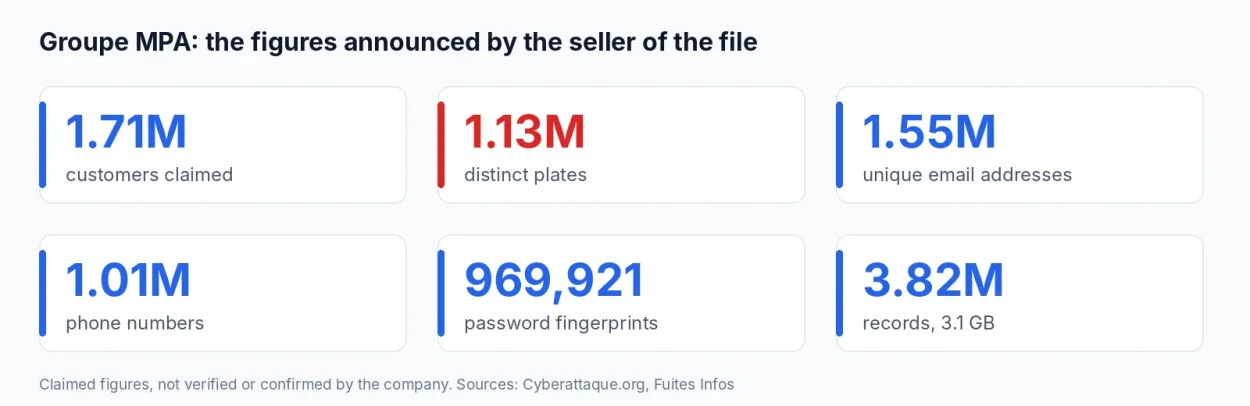
According to Cyberattaque.org, the file would hold 3,824,749 records for 3.1 GB, 1,713,120 customers, 1,133,713 distinct plates, 1,553,924 unique email addresses and 1,010,964 phone numbers. Fuites Infos rounds this to 3.8 million lines, 1.7 million customers, 2 million orders and 105,000 invoices. Fuites Infos stresses that these figures are announced but unverified, and that the hacker counts customers site by site without saying how many different people that represents.
The data involved
According to Fuites Infos, the file would mix:
- names, email addresses, phone numbers and postal addresses;
- orders, invoices and their amounts;
- license plate numbers;
- password fingerprints (so not plaintext passwords) and authentication tokens;
- for some customers, business data and VAT numbers;
- free-text fields entered at checkout and internal identifiers.
Fuites Infos analyzed a 3,000-line sample published with the announcement: each line can link a plate to the customer’s name, address, email and phone. The sample contains no readable password and no card number, and the most recent orders date from October 2026.
Cyberattaque.org also examined 3,000 records, from three files. Out of 1,000 orders, 600 contain at least one plate, and 562 out of 1,000 invoices mention one with a name and an address. Orders range from 2016 to October 19, 2026, but the date of the intrusion is not established. In 996 of 1,000 orders, the outlet found a 64-character hexadecimal fingerprint consistent with SHA-256, while Fuites Infos does not say which type of fingerprint it is. A plain SHA-256 without extra protection is not suited to storing passwords, Cyberattaque.org reminds readers, but MPA’s real setup is unknown.
What is not confirmed
- The leak itself: Fuites Infos writes that Groupe MPA has not publicly confirmed the alleged hack, and Cyberattaque.org found no confirmation. FrenchBreaches nevertheless lists the incident as confirmed and mentions 1.6 million accounts, and no statement from the company could be found.
- The volumes: 1.71 million customers matches neither the 1.55 million unique emails nor the million phone numbers, which may be explained by customers without email or shared contacts, but this is not demonstrated.
- The number of people: one customer may appear on several sites, and an order may have been placed for someone else.
- How current the data is: some lines go back to 2016. The file does not reproduce the official vehicle registration database.
Why a plate in a file is a problem
As FrenchBreaches explains in its analysis of plate leaks, a plate alone identifies a vehicle, and combined with a name, an address or a phone number it lets someone find a driver. The outlet cites the risks of fake fines, personalized scams, identity theft and tracking down someone’s home. It also notes that a plate alone does not prove that the current owner can be identified, since vehicles change hands. FrenchBreaches counts more than 19 million plates claimed in total across several recent leaks, with possible duplicates.
The real risk: phishing that knows your order
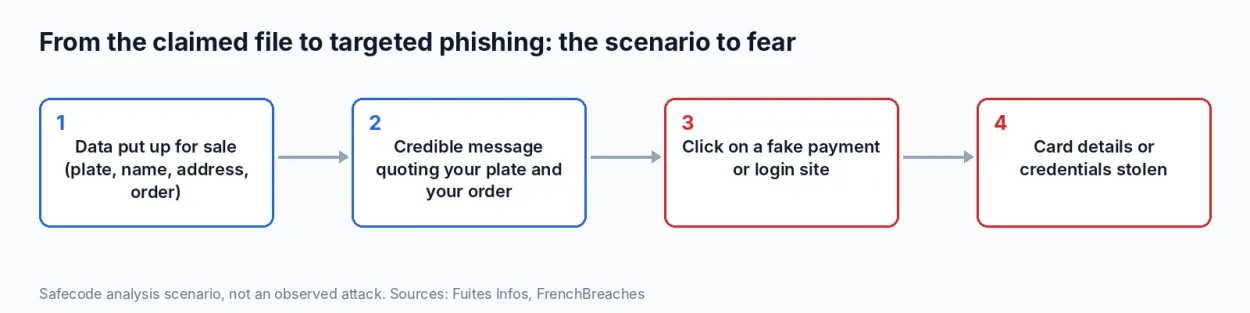
This part is our analysis. A typical phishing message is generic. With this file, a scammer could write to a customer quoting their name, address, plate and even their order of plates or stickers. They could claim a delivery problem, a refund, a “payment top-up” or a fine linked to that vehicle. The more precise the message, the more legitimate it looks.
What to do if you ordered from MPA
Here are the useful steps, based on Fuites Infos’ advice and usual common sense:
- Change the password of your MPA account, and of any other service where you reused it. Enable two-factor authentication where available.
- Be wary of messages quoting your plate or your order: even precise ones may come from the leak. Do not click a link you receive; go through the official site typed by hand.
- Never pay a fine through a link received by SMS or email: French fines are paid on the official site amendes.gouv.fr.
- Never share a code received by SMS, a password or banking details by phone or message.
- Report attempts and, if you are a victim, ask for free help at cybermalveillance.gouv.fr, as Fuites Infos recommends.
If the leak is confirmed, the GDPR requires the company to notify the French data protection authority (CNIL) within 72 hours, and to inform the people concerned when the risk to them is high.
Frequently asked questions about the Groupe MPA leak
A French group based in Marsannay-la-Côte, in the Côte-d’Or, that sells license plates, stickers and professional signage online.
Not by the company so far. Fuites Infos and Cyberattaque.org describe an unconfirmed claim, while FrenchBreaches lists it as confirmed.
Names, addresses, emails, phones, license plates, orders, invoices and password fingerprints, according to Fuites Infos. The sample contains no readable password or card number.
The hacker claims 1.7 million customers, counted site by site. The number of distinct people is unknown.
Highly credible phishing that quotes your name, plate and order, for example around a fake fine or a fake delivery problem.
