
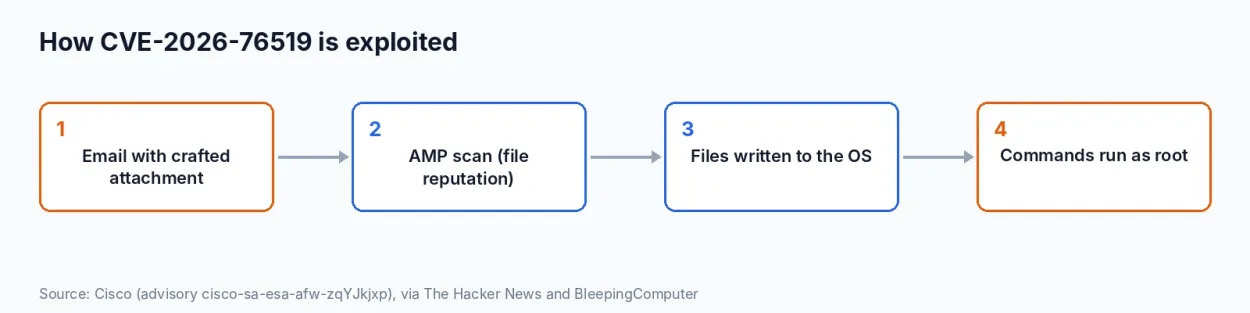
On 14 October 2026, Cisco confirmed that CVE-2026-76519, a flaw in its Secure Email Gateway, is already being exploited. Sending an email with a crafted attachment to a vulnerable appliance is enough to write files to it and, according to Cisco, run commands as root. Here is what we know, who needs to act and how to check whether an appliance was compromised.
What do we know about CVE-2026-76519?
The flaw sits in the Advanced Malware Protection (AMP) feature and stems from improper handling of email attachments: it is a path traversal (CWE-23) that lets an attacker write arbitrary files to the system. It is rated 9.8 out of 10 (CVSS 3.1) and is exploitable remotely, without authentication or user interaction, according to Cisco advisory cisco-sa-esa-afw-zqYJkjxp. Cisco published the advisory on 14 October 2026 and says its PSIRT became aware of active exploitation in October.
- Affected product: Cisco Secure Email Gateway, physical or virtual, running a vulnerable AsyncOS release. Secure Email and Web Manager and Secure Web Appliance are not affected.
- Two conditions: the File Reputation service (part of AMP) is enabled and assigned to a mail policy, and the Content Scanner Tools package is older than 25.3.0.5525.
- Fixed releases: AsyncOS 15.5.5-014 or 16.5.0-780. For the 16.0 branch there is no fixed build: Cisco says to migrate, and 16.0.4-302 does not fix this flaw, as reported by The Hacker News.
- Quick fix: Content Scanner Tools 25.3.0.5525 or later also contains the fix, and installs without an upgrade or restart.
- Workaround: none, according to Cisco.
Exploited since October, with no attribution
Cisco gives no exploitation start date, no number of compromised appliances and no attacker. It says it contacted Secure Email Cloud owners where possible indicators of compromise were found, and deployed the fix on its managed gateways, as explained by SecurityWeek. Shadowserver counts nearly 300 Cisco gateways exposed to the Internet, without saying how many are honeypots or already protected, as written by BleepingComputer.
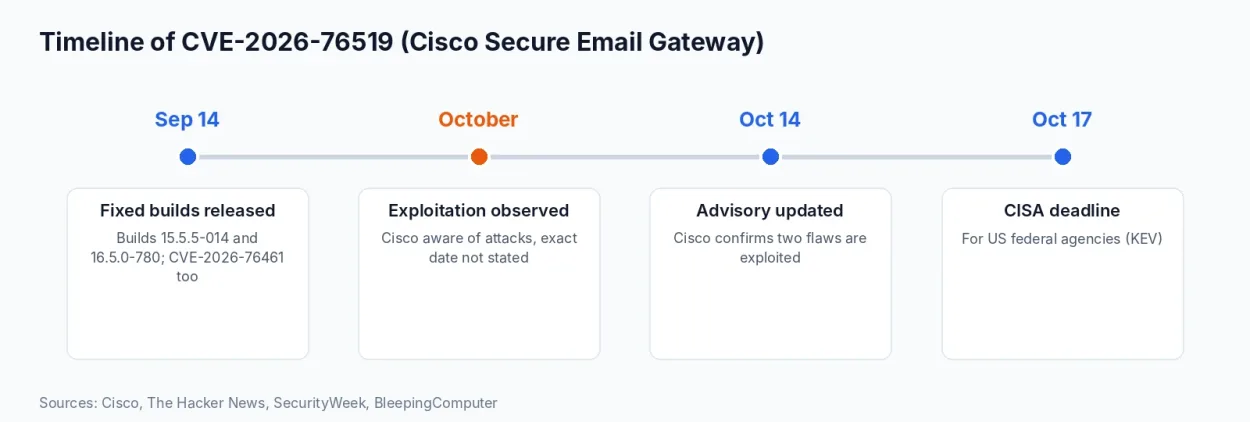
Another point worth noting: fixed releases have been shipping since 14 September, a month before the alert. Appliances that were not updated stayed exposed even though a fix existed.
A second exploited flaw on the same gateway
This is not the first alert this autumn. CVE-2026-76461, an SQL injection in email parsing that also allows unauthenticated root command execution, was disclosed on 14 September and added to CISA’s Known Exploited Vulnerabilities (KEV) catalog the same day. Cisco does not link it to the current attacks. The vendor also updated its September advisory to say that two of the flaws it groups are exploited: this one and CVE-2026-76461, as noted by The Hacker News.
This product line is already a recurring target: CVE-2025-20393, exploited as a zero-day since November 2025 and patched in January 2026, was attributed to a China-linked group tracked as UAT-9686. Nothing establishes a link to the current attacks at this stage.
What to do if you use Cisco Secure Email Gateway
- Check your exposure: in the web interface, go to Mail Policies then Advanced Malware Protection and see whether File Reputation is enabled; on the command line,
contentscannerstatusshows the Content Scanner Tools version. - Apply the quick fix with
contentscannerupdate, or turn on automatic updates under Security Services then Service Updates. Then plan the migration to a fixed AsyncOS release, at least 16.5.0-780 for anything older. - Look for signs of compromise with
grep "System Security" system_logs, on every cluster member. The message “Suspected compromise indicator was found” means you should treat the appliance as compromised and contact Cisco TAC; “Security scan did not complete” also calls for contacting TAC. - Don’t rely on a negative result: an attacker with root can erase their tracks. Review firewall and network logs outside the appliance for uploads to external addresses or downloads from malicious IPs.
- If a physical appliance is compromised, contact TAC and enable remote access for its engineers.
- For a virtual machine, preserve forensic data first, since upgrading destroys logs, then deploy a new VM on a fixed release, rebuild the configuration without importing the old one, renew credentials and cryptographic material, and monitor.
- In a cluster, Cisco recommends restoring every member as soon as one is compromised, because members authenticate to each other with SSH key pairs.
According to SecurityWeek, CISA added CVE-2026-76519 to its KEV catalog on 14 October, with a 17 October deadline for US federal agencies. The Hacker News and BleepingComputer do not mention it, so we give this with that caveat.
And if you are not directly affected?
If your organization does not use this product, there is nothing to do. But an email gateway sees all of a company’s mail: compromising it gives access to email in transit and a foothold inside the network. Providers that filter your email with this product are worth asking about their patch status.
Sources: Cisco, advisory cisco-sa-esa-afw-zqYJkjxp, The Hacker News, SecurityWeek and BleepingComputer.
Frequently asked questions about Cisco flaw CVE-2026-76519
It is an email gateway that filters inbound and outbound mail (spam, malware, phishing) before it reaches users’ mailboxes.
It is if File Reputation is enabled and assigned to a mail policy, and Content Scanner Tools is older than 25.3.0.5525.
No. Only updating Content Scanner Tools or AsyncOS fixes the flaw.
Yes. Cisco confirmed active exploitation in October 2026, without naming an attacker or giving figures.
Run grep “System Security” system_logs on each appliance and cross-check with network logs, because a negative result does not prove there was no compromise.

Leave a Reply