

Using an AI-powered voice recorder such as the Plaud Note Pro or NotePin naturally raises questions about privacy and data security.
The device records in two modes: in-person conversations through its built-in microphones, and phone calls through a vibration sensor that picks up sound directly from the phone’s speaker. We are talking about your business conversations, your strategy meetings or your confidential interviews travelling from a device to your smartphone and through servers, in this case the manufacturer’s, before being transcribed and analysed by artificial intelligence models.
Given the amount and sensitivity of the information this kind of tool can collect, here is an overview of Plaud AI’s security as of January 2026: certifications obtained, independent audits, data hosting and legal guarantees offered to European users.
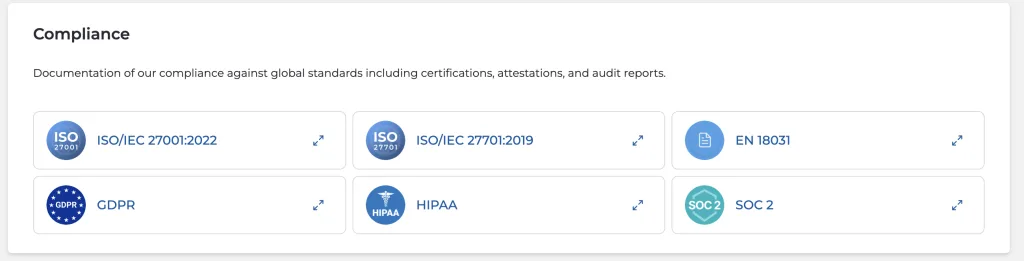
Plaud Note security certifications
Plaud AI has obtained several certifications. The company is SOC 2 Type II compliant, which attests that rigorous controls are in place to maintain the confidentiality, integrity and availability of data. This certification requires an annual independent audit by a third party.
HIPAA (Health Insurance Portability and Accountability Act) compliance allows the Plaud Note to be used in the US healthcare sector.
The ISO 27001 and ISO 27701 standards complete the picture. ISO 27001 establishes an information security management system (ISMS), while ISO 27701 focuses specifically on privacy management.
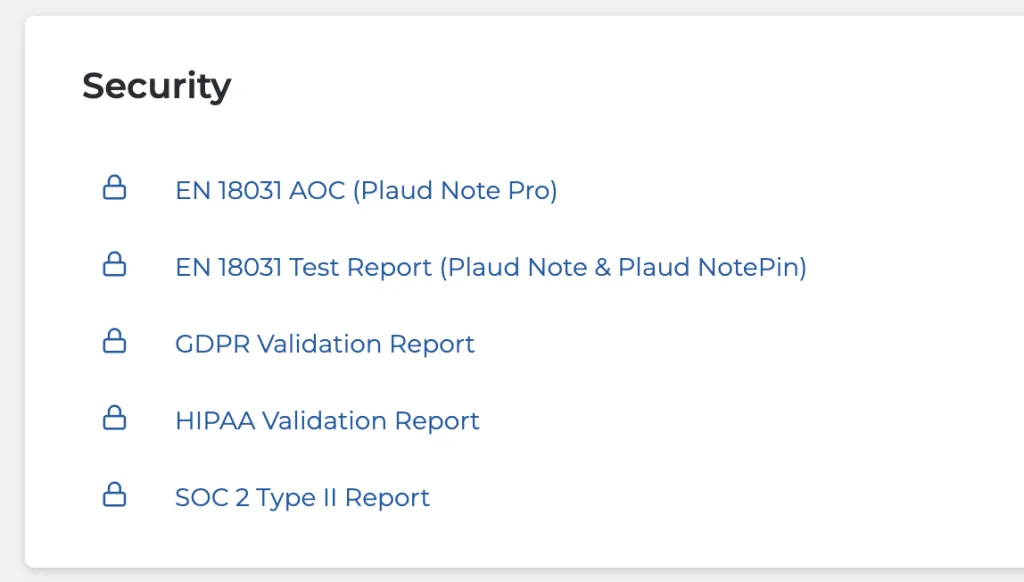
European EN 18031 certification
The Plaud Note has obtained EN 18031:2024 certification, a European cybersecurity standard specific to internet-connected radio equipment. It validates the security of wireless communications (Bluetooth, Wi-Fi) and the processing of personal data.
Plaud has EN 18031 test reports for its three devices (Plaud Note, Plaud Note Pro, Plaud NotePin), as well as a specific attestation of conformity (AOC) for the Plaud Note Pro.
Important: the device does not implement any password authentication. Access to recorded data is controlled by secure Bluetooth pairing with the user’s smartphone. Only the previously paired phone can connect to the Plaud Note, so security relies directly on the protection of the smartphone itself.
GDPR compliance and the European market
In July 2025, Plaud AI announced full compliance with the European Union’s General Data Protection Regulation (GDPR). This milestone is part of the company’s expansion strategy in European markets, where it now sells its products through Amazon, MediaMarkt, Fnac and other major retailers.
GDPR compliance comes with several obligations:
- Plaud AI must inform users transparently about how their personal data is collected, used and stored.
- European users have the right to access, rectify, erase and port their data.
- In the event of a breach, the company must notify the supervisory authority (the CNIL in France) within 72 hours, and inform the people concerned without undue delay if the breach poses a high risk to their rights and freedoms, as set out in Article 33 of the GDPR – Notification of a personal data breach to the supervisory authority.
You can find all of Plaud’s compliance information and reports on Drata. To access the reports, you need to submit a request:
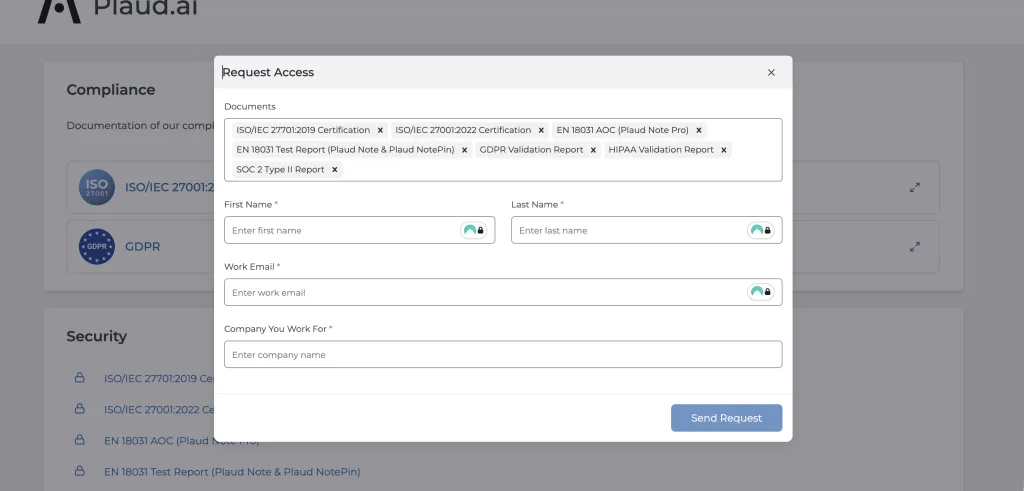
Hosting infrastructure and data processing
Hybrid cloud architecture
The Plaud Note relies on a hybrid cloud architecture. Audio recordings are first stored locally on the device, then automatically transferred to cloud servers for transcription and analysis by AI models.
By default, the resulting files (transcripts, summaries) are kept locally on the device and are only synced to the cloud if the user explicitly enables Private Cloud Sync (PCS). AI processing, however, always passes temporarily through the LLM providers’ servers.
Plaud AI uses the infrastructure of three major cloud providers: Microsoft Azure, Google Cloud Platform (GCP) and Amazon Web Services (AWS).

This multi-cloud approach aims to provide:
- Geographic redundancy: spread across 3 regions (North America, Asia-Pacific, Europe)
- High availability: no dependency on a single provider
- Performance: routing to the geographically closest server
- Local compliance: meeting data residency requirements by region
Data location and sovereignty
It is worth distinguishing the overall infrastructure from the infrastructure dedicated to users’ AI data. While Plaud does use a multi-cloud environment (Azure, GCP, AWS) for its services in general, its official policy states that AWS is the provider used to store AI data when Private Cloud Sync is enabled, with servers located in the United States. Users cannot currently choose the storage region.
Data is distributed across these platforms based on geolocation and load criteria. The company says it is working on using local servers depending on the user’s country. However, this feature had not yet been rolled out at the time of this analysis.
Plaud Note technical architecture
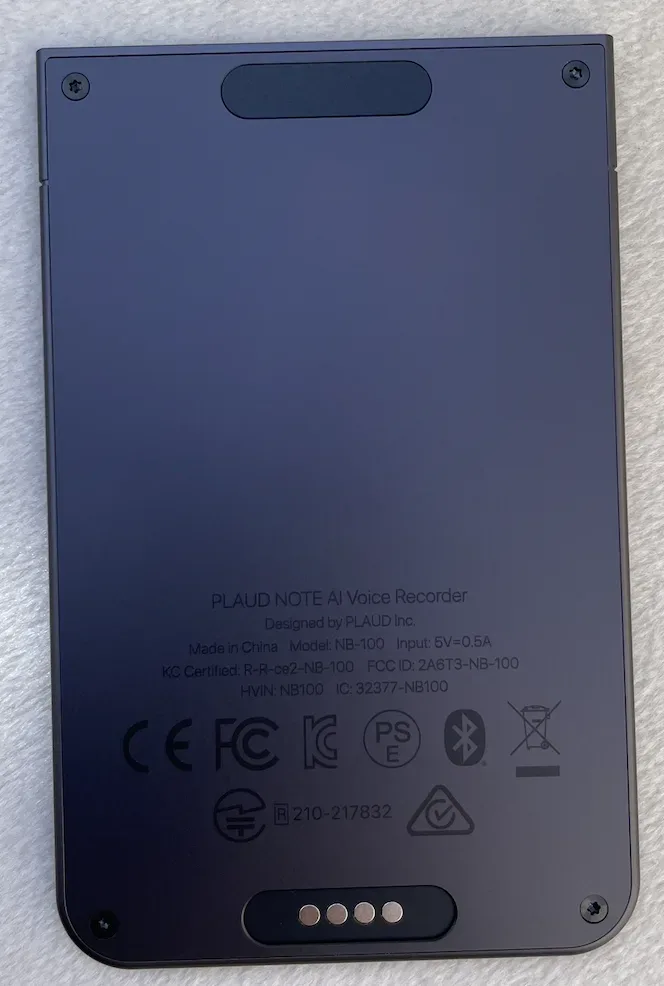
The architecture relies on two separate communication chips: the RTL8722 for Wi-Fi and the RTL8762E dedicated to Bluetooth Low Energy 5.0. This setup optimises battery life by keeping an ultra-low-power Bluetooth connection always on (5.3 mA when receiving) while allowing fast, occasional Wi-Fi transfers.
The Plaud Note is built on the following components:
- SoC (System on Chip): RTL8722
- Operating system: FreeRTOS V10.2.0
- Communication chips: RTL8722 (Wi-Fi) + RTL8762E (Bluetooth Low Energy 5.0)
- Physical interfaces: button, indicator LED, microphone, lanyard loop, USB-C charging port
- Storage capacity: 64 GB
- Battery life: up to 30 hours of continuous recording
Encryption and transmission security
Data stored on the servers is encrypted at rest with AES-256, a military-grade standard recognised for its robustness. For transmissions between the device, the mobile app and the cloud servers, Plaud uses TLS 1.3 (Transport Layer Security), the most recent version, to ensure the confidentiality and integrity of data in transit.
An additional application-level encryption layer applies specifically to personally identifiable information (PII), as documented on Plaud’s Trust page.
Plaud says it uses a secure random number generator (Secure RNG) to generate cryptographic keys, and that protection against replay attacks is also implemented for communications.
Automatic security updates
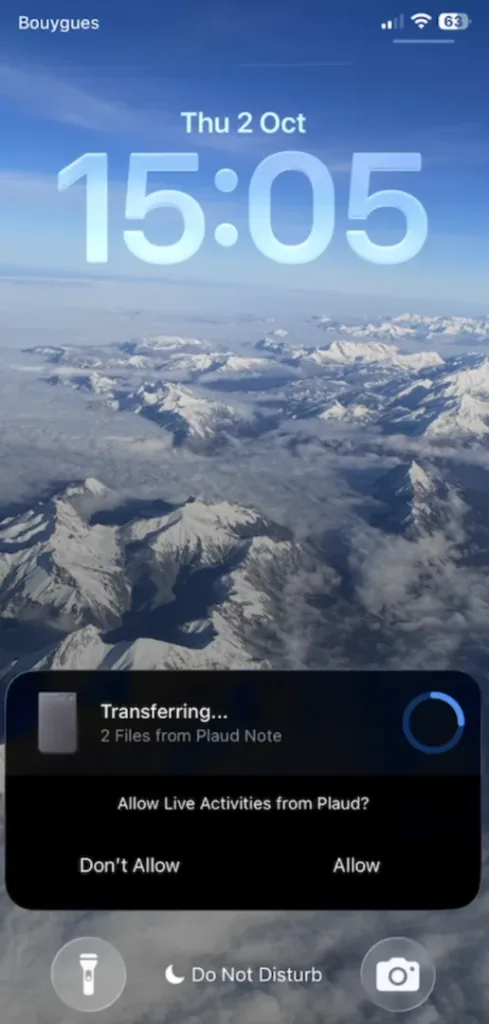
The Plaud Note implements an automatic update mechanism. Firmware updates can be deployed remotely to fix potential vulnerabilities. This capability is essential to maintain the security level throughout the product’s lifetime.
The Plaud Note has a secure update system compliant with EN 18031, which ensures that firmware updates are cryptographically verified before installation. Any attempt to inject malicious code or modified firmware is automatically rejected by the device. The Plaud Note can only install firmware updates officially signed by Plaud AI.
The precise technical details of the cryptographic signature (algorithm, key length, revocation process) and whether secure boot is present are not publicly documented.
How AI models use the data
One concern is the potential use of recordings to train or improve artificial intelligence models. This practice, common among some AI service providers, can raise major privacy issues.
Plaud AI explicitly guarantees that your data will not be used by OpenAI to train its models. This protection relies on OpenAI’s policy for its API customers, which states that data submitted through the API is not used to train or improve its models unless the customer explicitly opts in to share it for that purpose.
This guarantee applies to transcripts generated through OpenAI’s Whisper API and to summaries produced by GPT-4o. Your business conversations stay private and do not contribute to improving the underlying models.
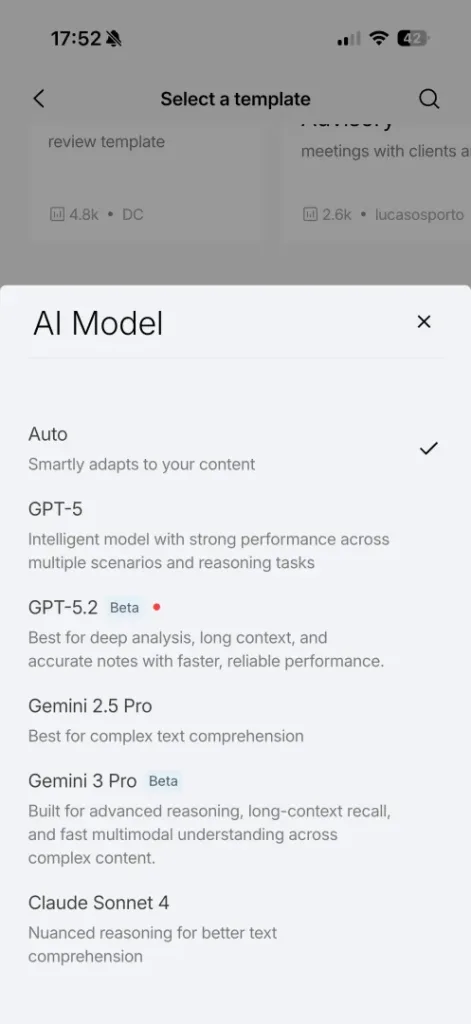
Plaud also uses Anthropic’s Claude and Google’s Gemini as alternative models. These providers apply similar policies of not using API data to train their models. You can choose your preferred model in the app settings.
The language models used (GPT-4o, Claude Sonnet, Gemini 2.5 Pro) process your recordings to generate transcripts and summaries. According to Plaud’s official policy (AI Data Usage Transparency Policy, updated July 2025), data is sent to the LLM providers in real time for processing, then deleted immediately with no retention on the provider’s side. Functionally, this approach is close to Zero Data Retention (ZDR) for the AI layer, even though Plaud doesn’t use that term in its documentation. The distinction matters, as ZDR in the strict contractual sense remains rare in the industry.
User controls and data management
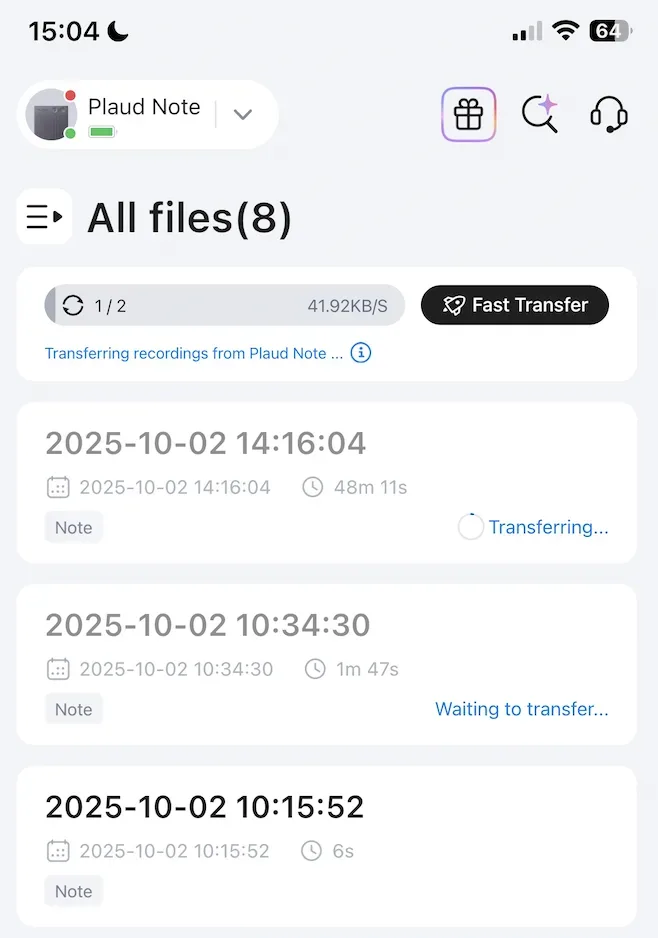
The Plaud app offers several controls over your data. You can customise how long your recordings are kept and permanently delete files you no longer need. Deleting a recording erases the audio, the transcript and the associated summaries. Deletion is entirely manual and takes two steps: move the file to the bin, then delete it permanently. There is no setting for automatic deletion after processing. In practice, without strict discipline, recordings pile up in the app, which mechanically increases the exposure if the account is compromised.
You keep full ownership of your content. You can export all your data in more than 27 formats (MP3, TXT, DOCX, PDF, etc.), which makes it easier to move to other solutions if needed.
Plaud’s unlimited cloud storage is an advantage, but it raises questions about retention periods. GDPR best practice is to keep data only for as long as strictly necessary for its purpose. You should therefore define a retention policy suited to your needs and regularly delete obsolete recordings. Realistically, and without wanting to sound pessimistic, most conversations will simply accumulate, along with the associated risks…
The app also offers a “Raw Files” feature that gives access to the raw audio files before processing. This can be useful to keep unaltered evidence of a conversation, or to reprocess the audio with another system if needed.
Limitations and points of caution
Despite the certifications and security guarantees, some limitations deserve your attention. The lack of a public API prevents the Plaud Note from being integrated with internal company systems. For example, you cannot automatically route transcripts to your internal document management system or apply your own custom security rules.
It also means you cannot use self-hosted local language models.
An exception used to exist for Mac users via the AideAI app. This third-party solution automatically synced Plaud recordings and processed them locally on your computer. All audio files, transcripts and summaries then stayed stored locally, without passing through the cloud services mentioned above. This approach significantly improved privacy, but required a Mac, the (paid) AideAI app and a more complex technical setup. Unfortunately, the article describing it was removed in early April 2026.
Mandatory cloud processing for transcription and summaries means your recordings temporarily leave your direct control. Despite everything covered above, a residual risk always remains during transit and processing on third-party servers.
There is no ZDR (Zero Data Retention) mode: the app offers no setting to automatically delete files after processing. Audio files are, however, automatically deleted from the hardware after syncing to the app, but they remain in the app until the user explicitly deletes them.
I’ll leave everyone to carry out their own risk analysis based on their needs.
Legal aspects of recording in France
Beyond technical security, using the Plaud Note raises legal questions.
Legal consent requirements
In France, Article 226-1 of the Criminal Code strictly prohibits recording a private conversation without the participants’ knowledge. You must inform everyone present and obtain their explicit consent before any recording.
This obligation applies to in-person meetings as well as phone calls. Failing to comply is an invasion of privacy punishable by one year in prison and a €45,000 fine. A visible recorder is not enough on its own: you must explicitly tell participants that you are recording.
Workplace context and GDPR
In a professional setting, recording internal meetings may be subject to the company’s internal rules and require informing the works council (CSE in France). Regulated professions (lawyers, doctors, journalists) must also comply with their specific codes of ethics.
Using and storing recordings must comply with the GDPR. If your recordings contain personal data, you must inform the people concerned of the purpose of the processing, the retention period and their rights. Sharing a recording without the participants’ permission exposes you to civil and criminal liability.
Risks of misuse
Like any discreet recorder, the Plaud Note could technically be used for industrial espionage or unauthorised surveillance. Its compact size (credit card format, 2.9 mm thick) and the lack of a visible indicator light while recording potentially make it easier to use without participants knowing. That is precisely why French law imposes strict obligations.

Responsibility for ethical and legal use of the device lies entirely with the user. Plaud AI provides the technical tool and reminds users of their legal obligations through its Privacy Reminder, but the company cannot physically prevent malicious use. In a sensitive professional context (commercial negotiations, strategic discussions, confidential interviews), you should set clear usage rules and make your teams aware of the legal risks of unauthorised recording.
Special recording cases
For recording to take personal notes (not as contractual evidence), informing people orally is enough. If you record to prove that a contract was formed (telemarketing, phone sales), you must keep proof of consent and the recording can only be started manually, and only when the conversation concerns concluding the contract.
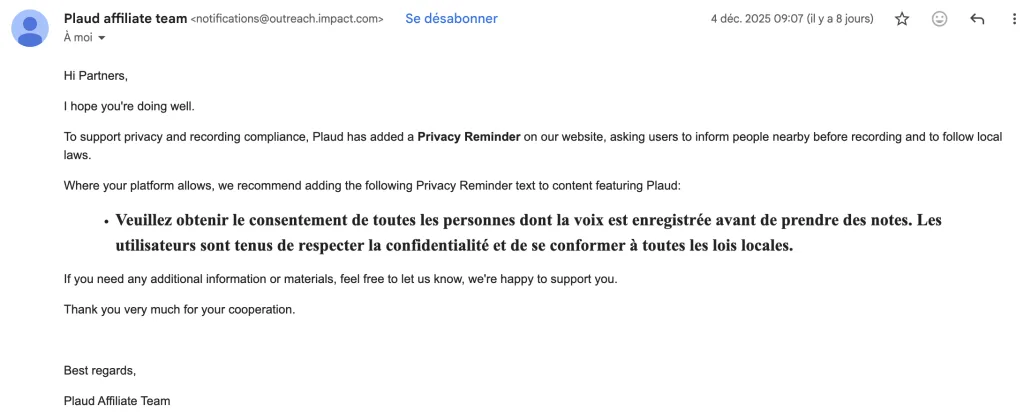
Plaud AI supports its users in meeting these legal obligations. The company sent a “Privacy Reminder” to its affiliate network stressing the importance of informing people before any recording, the need to obtain the consent of everyone whose voice is recorded, and the obligation to comply with applicable local laws.
Plaud Note security assessment: conclusion
The Plaud Note offers a reasonable level of security for normal professional use. The certifications it has obtained show a serious approach to data protection. The guarantees that data is not used to train AI models are reassuring when it comes to privacy.
Cloud storage is not systematic: without Private Cloud Sync enabled, transcripts and summaries stay on the device. AI processing, however, always passes temporarily through the LLM providers’ servers, whatever the configuration, and that flow is the main point of caution for sensitive uses.
For everyday professional use (internal meetings, client interviews, project documentation), the Plaud Note strikes an acceptable balance between convenience and security.
Tests performed for each certification
For those of you who want to understand in concrete terms what the certifications mentioned above actually validate, here is an overview of the main tests performed.
SOC 2 Type II
Specificity: verifies that controls actually operate over a 3-month period (whereas Type I checks that they exist at a given point in time)
Infrastructure security tests:
- Active monitoring of intrusion detection and prevention systems (IDS/IPS)
- Verification of the web application firewall (WAF) and automatic alerts
- Effective encryption of storage
- Regular vulnerability scans and patch deployment
Organisational tests:
- Sample of employees: security training completed, access revoked <24h after leaving
- Mandatory multi-factor authentication on sensitive systems
- Phishing simulations and incident response exercises
ISO 27001/27701: security management system
Audited areas:
| Area | Checks |
|---|---|
| Risk management | Risk register with owner, likelihood/impact, treatment |
| Business continuity | Incident response and disaster recovery plan, regularly tested |
| Subcontractors | GDPR-compliant DPAs and documented risk assessment |
| Logging | Centralised logs and automatic alerts on abnormal behaviour |
| Privacy (27701) | Documentation of data subject rights (access, rectification, erasure) |
HIPAA: protecting medical data
Use: allows use in the US healthcare sector (consultations, medical discussions)
Specific tests:
- Encryption of electronic protected health information (ePHI)
- Full traceability of access to systems containing ePHI
- Subcontractor agreements with medical data protection clauses
- Notification procedures meeting US federal deadlines
EN 18031: hardware-level cybersecurity
Focus: security of the physical device and wireless communications
Tests performed:
| Component | Validation |
|---|---|
| Firmware | Secure update mechanism with cryptographic verification |
| Internal storage | Protection against unauthorised access |
| Communications | Bluetooth/Wi-Fi security in line with European standards |
| System | SoC, embedded OS and cryptographic key generation |
| Code security | Input validation against injections |
| Vulnerabilities | No known CVEs in the components |
GDPR: European data protection compliance
Focus: compliance with the European Union’s General Data Protection Regulation
Audited areas:
| Area | Checks |
|---|---|
| Legal basis | Identification of the legal basis for each data processing activity |
| Data subject rights | Procedures for access, rectification, erasure, portability and objection |
| Breach notification | Process for notifying the supervisory authority within 72h and informing the people concerned |
| Record of processing | Complete documentation of processing activities |
| DPO and governance | Appointment of a data protection officer |
| International transfers | Safeguard mechanisms for transfers outside the EU |
| Minimisation | Checking that only necessary data is collected |
| Retention period | Documented and enforced retention policy |
Plaud Note security FAQ
Yes, Plaud AI achieved GDPR compliance in July 2025.
No, Plaud AI guarantees that your data will not be used to train OpenAI’s models unless you give explicit consent. This protection applies through OpenAI’s API policy.
By default, transcripts and summaries are kept locally in the app. They are only synced to the cloud (AWS, US servers) if you explicitly enable Private Cloud Sync. AI processing itself always passes temporarily through the LLM providers’ servers (OpenAI, Anthropic, Google), whatever the configuration.
No, there is no public API to integrate the Plaud Note with your internal systems. An exception existed for Mac via the AideAI app, which allowed local processing.
No. Although Plaud is HIPAA compliant (a US standard), the company does not hold the HDS certification required in France to host health data. French healthcare organisations must check compliance with the ANS PGSSI-S framework before any use.
Plaud states that deleting a recording in the app erases the audio, the transcript and the associated summaries from Plaud’s servers.
You must inform all participants and obtain their explicit consent. Recording people without their knowledge is prohibited by Article 226-1 of the French Criminal Code.
SOC 2 Type II, HIPAA, GDPR, ISO 27001, ISO 27701 and EN 18031 for secure wireless communications.
Yes, Plaud makes its compliance reports (SOC 2, ISO 27001/27701, GDPR, HIPAA, EN 18031) available through a trust portal. Access requires a request with professional identification.

Leave a Reply