
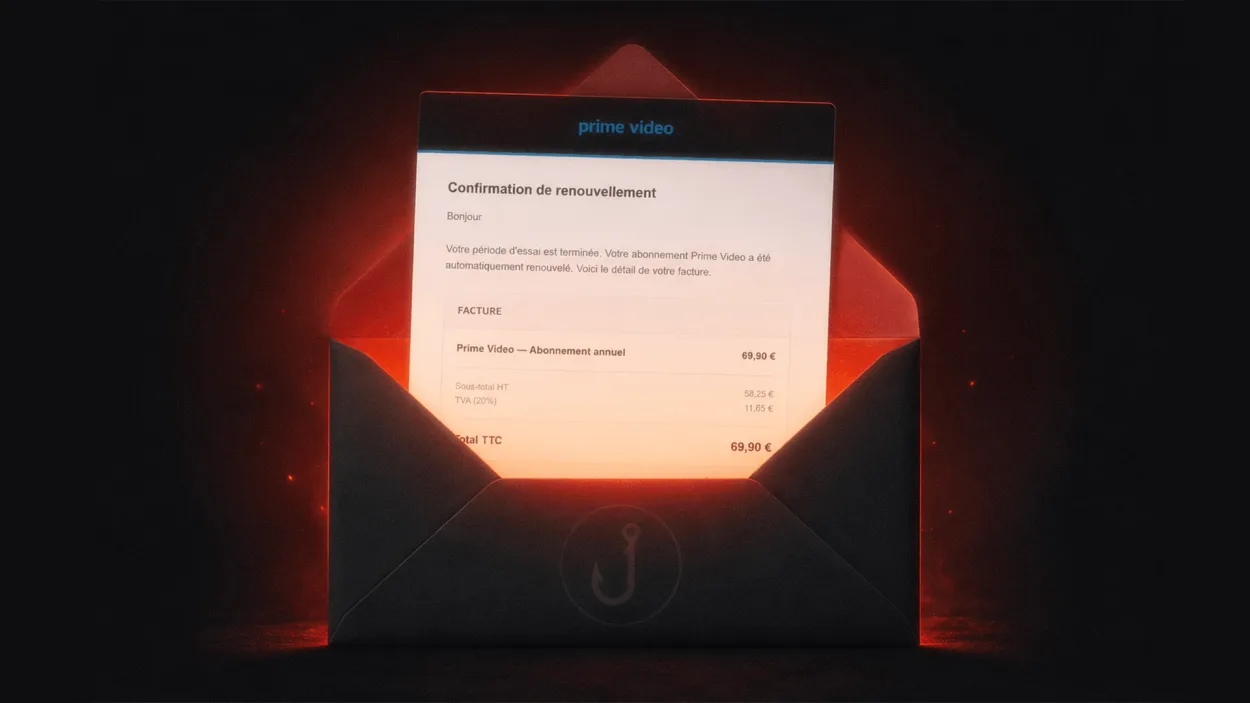
Have you received an email telling you that your Prime Video subscription has just been automatically renewed for €69.90, with your name, your IBAN and a button to “manage your subscription”? You don’t remember signing up, or you’re not sure? It is probably a scam! Here is how to find out in two minutes whether it is real or a scam, and what to do in each case.
Is this Prime Video email a scam?
In the vast majority of cases reported since spring 2026, yes: it is a scam. A fraudulent email that perfectly imitates Amazon’s layout and is circulating widely in France. It shows an amount of €69.90, your first name, your surname and sometimes your real IBAN.
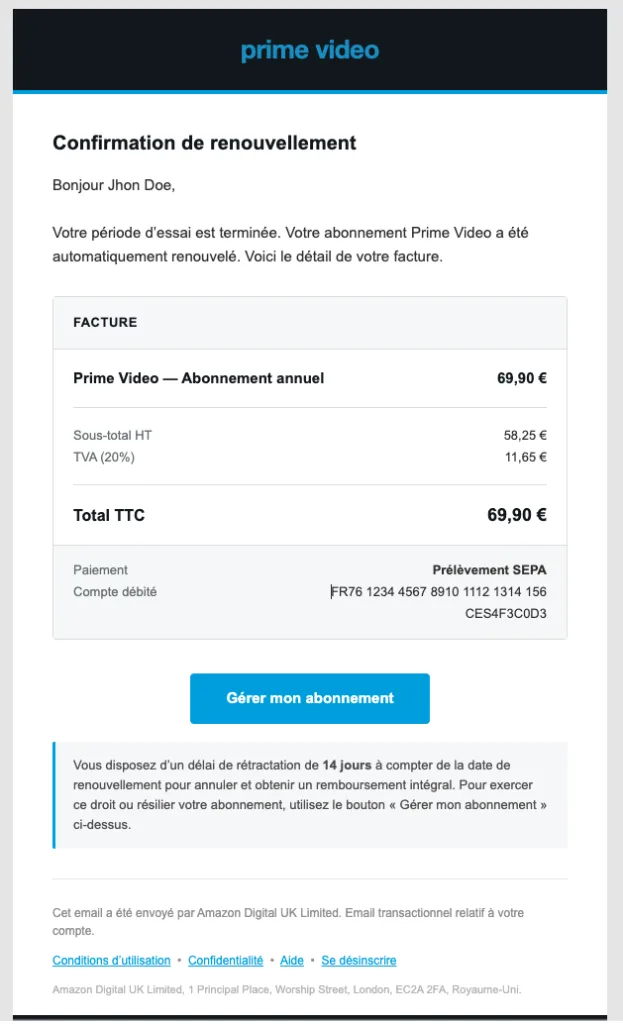
But before you panic, check just one thing: the sender’s email address. To do this, open the email and display the sender’s full address (not just the display name “Prime Video”, but the address between angle brackets). An email from Amazon always comes from a domain ending in @amazon.fr, @amazon.co.uk or @amazon.com. If you see anything else, such as @classplus.co or @testbook.com, it is a scam. Don’t click anything.

How to check whether you have really been charged
Don’t look for the answer in the email you received. Do these two checks directly at the source:
- On your bank account: check your latest transactions. An Amazon or Prime Video debit would appear with the label “AMAZON” or “PRIME VIDEO”. If there is nothing, you have not been charged.
- On your Amazon account: open your browser, type
amazon.fr(or your local Amazon site) yourself, without using the links in the email, log in, then go to “Account & Lists” > “Memberships & Subscriptions” > “Prime”. You will see the real status of your subscription and the next renewal date.
These two checks take less than two minutes and give you a definite answer, without having to click anything in the suspicious email.
Why does the email know my name and IBAN?
Many people ask this, and it is a fair question: if the email shows your real IBAN, it must be genuine, right? No, but then how is it possible if it comes from scammers?
The answer is simple: your details were exposed in a data breach unrelated to Amazon. In recent years, many companies (Bouygues, Orange, Auchan, Allianz, the French Football Federation, Workday, PayPal) have suffered hacks that put databases containing names, email addresses and bank details into circulation. Scammers buy these databases and use them to personalise their fraudulent emails, making them far more convincing.
So the presence of your IBAN in a fraudulent email does not mean Amazon has been hacked, nor that your data was stolen recently.
My IBAN is in the email: is that dangerous?
An IBAN alone does not allow anyone to empty a bank account. To make a SEPA direct debit, a creditor must have a mandate signed by you. In practice, unauthorised debit attempts do happen, but they can be disputed.
If your IBAN appears in a fraudulent email, let your bank know. It can monitor unusual incoming debits or block them on request. In France, any unauthorised SEPA direct debit can be disputed within 13 months: your bank is required to refund you.
Changing bank accounts is generally not necessary, unless you notice repeated unauthorised debits.
I clicked a link in the email: what should I do?
If you clicked “Manage my subscription” but did not enter anything, the risk is low. Close the page and do not go back to the link.
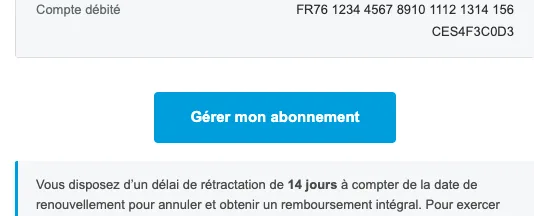
Otherwise, your browser warns you that the site is not secure (the well-known https, or the padlock in some browsers):

You are then redirected to the malicious site https://amazon-prime[.]club/, which looks exactly like the official Amazon site. It even reuses your first name, which was already in the malicious email:
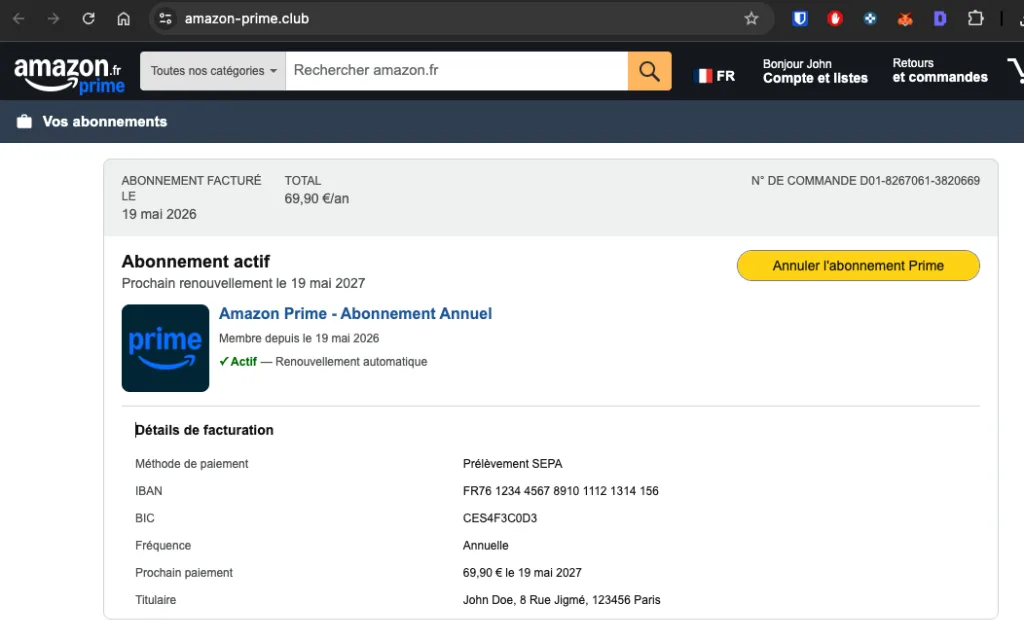
The attacker’s goal is to get you to click “Cancel Prime subscription”, which redirects you to a fake page asking you to verify your personal information:
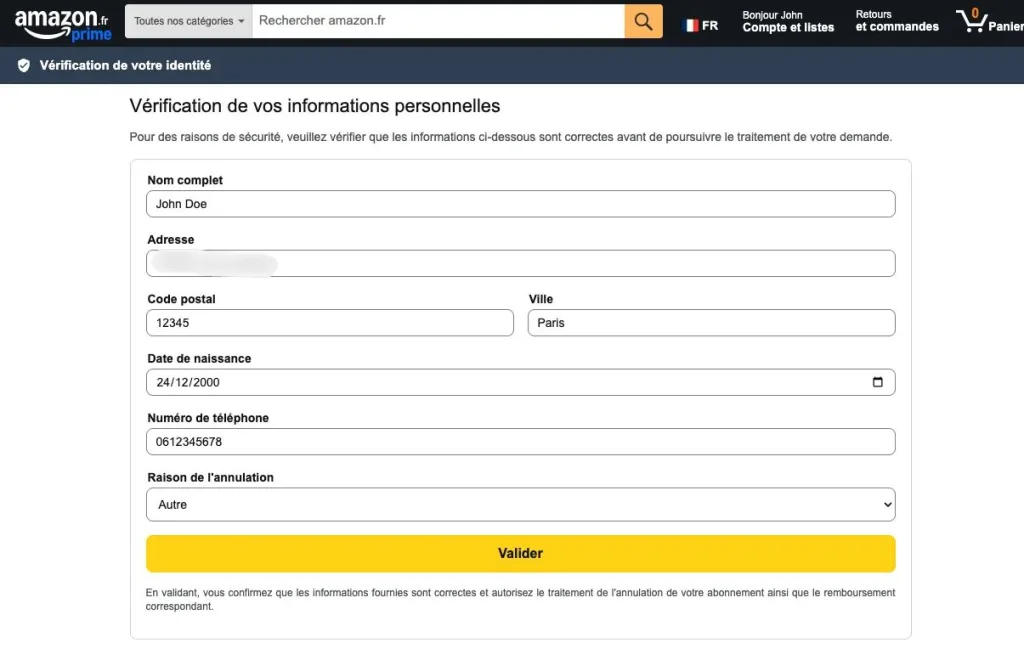
In my case, the phone number had not been filled in, giving the attacker an opportunity to enrich their database about you. When you submit the form, you are redirected to the most dreaded page of all: the payment details page.
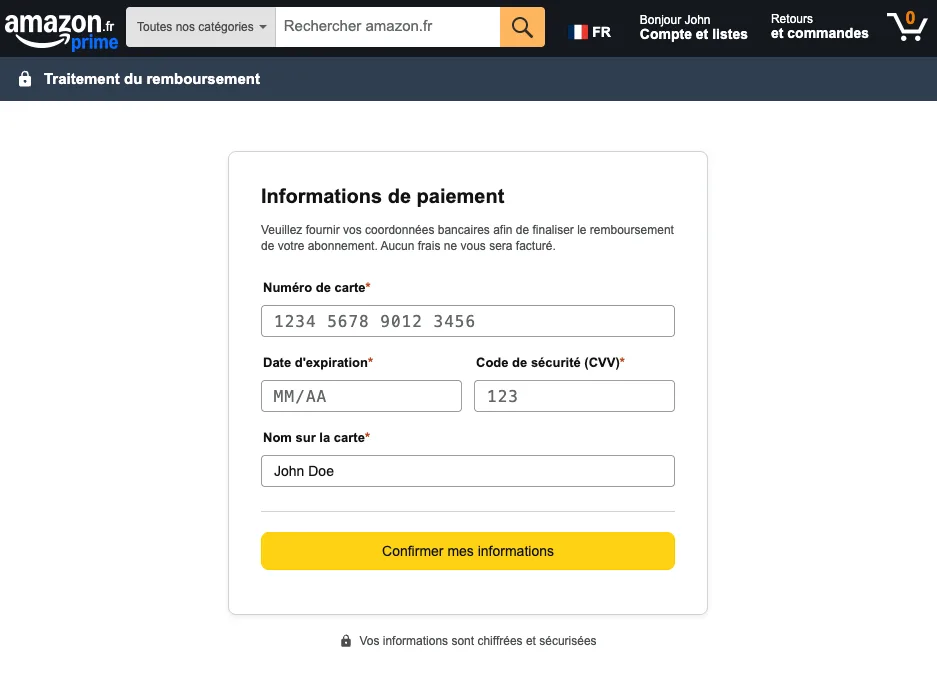
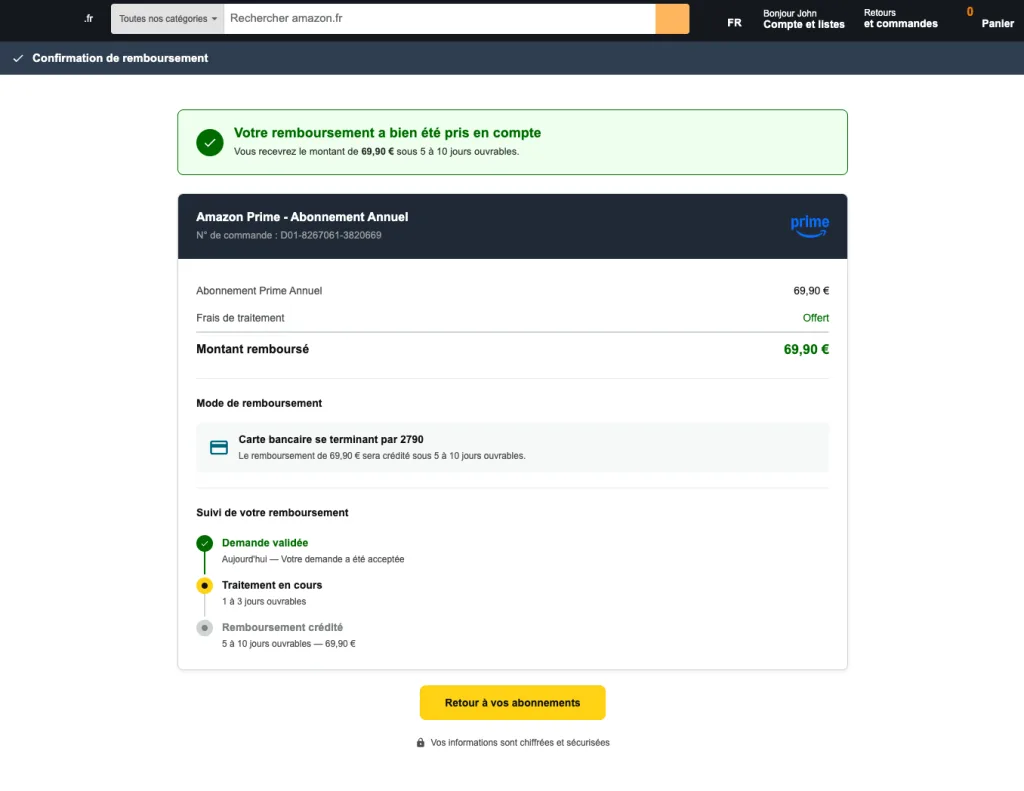
I went through the whole scam process for you by entering a fake credit card, which the malicious site did not detect, and here is the final page. Notice that some icons no longer display. Attackers put in less effort once they have stolen your information 🙂
If you shared bank details or a card number, call your bank right away to block your card.
Note: remember that it is not normal to have to enter your credit card to cancel a subscription to a service.
Where to report this scam
In France, two official platforms let you report this type of email:
- Signal Spam to report the fraudulent email directly
- Cybermalveillance.gouv.fr if you are a victim and need guidance
If you have suffered a financial loss, file a complaint with the police. In France, you can also do it online.
Prime Video renewal email scam FAQ
In most cases reported in 2026, yes. Check the sender’s address: a legitimate Amazon email always comes from an @amazon.fr, @amazon.co.uk or @amazon.com domain. Then log in directly on Amazon to check the real status of your subscription, without clicking the links in the email.
Yes, if you had signed up for a free trial that turned into an annual subscription. But check your bank account and your Amazon account directly first: it is the only way to be sure. Do not rely on the email you received to answer this question.
Your details were probably exposed in a data breach at another service, unrelated to Amazon. Scammers use these databases to personalise their emails and make them more credible. Let your bank know, but don’t panic: an IBAN alone is not enough to make a transfer from your account.

Leave a Reply