

France’s national cybersecurity agency was caught out by a flaw in third-party software. In late September, ANSSI revealed that its innovation lab, along with two services of DINUM, the inter-ministerial digital directorate, were compromised through a vulnerability in Metabase, a data analytics tool. Here is what happened, what leaked and what to take from it, whether you are a user or an administrator.
What happened at ANSSI and DINUM?
The attackers exploited CVE-2026-72898, a critical SQL injection that affects Metabase without any authentication. According to the CERT-FR alert, it gives access to the application’s database and can grant the attacker administrator rights on the instance. Metabase released the fix on 6 August 2026, and CERT-FR issued its alert on 10 September, after seeing “numerous compromises” of vulnerable instances, according to the alert CERTFR-2026-ALE-010.
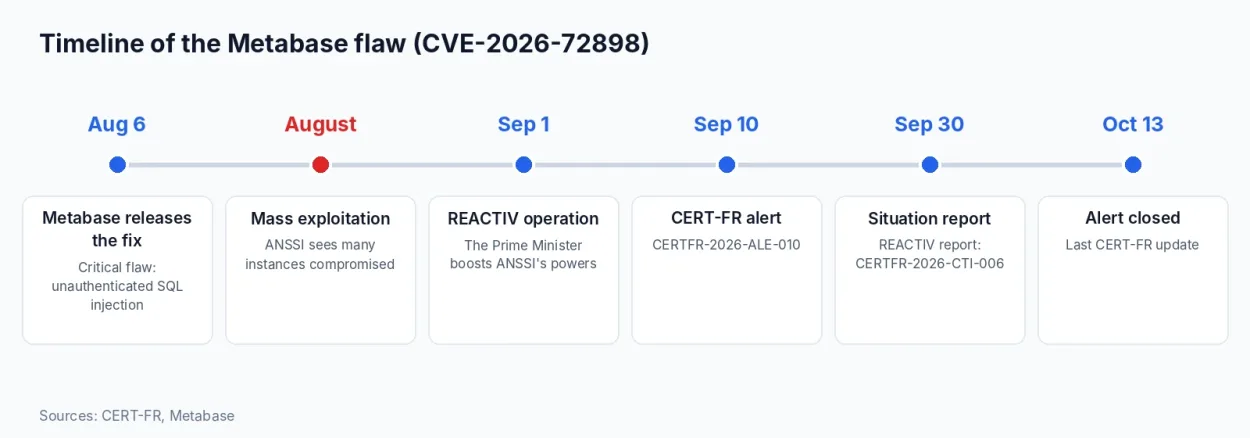
Both organisations were hit in this context, according to figures relayed from ANSSI’s report:
- ANSSI innovation lab: 118 Metabase accounts compromised, including about 30 external users. The data concerned is usage statistics, usernames, email addresses and password hashes.
- DINUM: two instances compromised, linked to ProConnect and Nuage-Public. The data is administrative information on public bodies (SIREN, SIRET, budgets, headcount), metadata on contributions to open source projects and anonymised login histories. ANSSI says this data was already public.
According to the REACTIV status report published by CERT-FR on September 30 (CERTFR-2026-CTI-006, Leto and IT-Connect), nine public-sector Metabase instances were compromised. Cases cited include the France VAE portal (compromised on August 8, with all user data exfiltrated), Qualicharge (about 102,000 charging sessions and around 100 technical accounts) and Zéro Logement Vacant, where a breach affecting 48 million property owners is claimed, with a Metabase instance as the presumed entry point. The report also counts 99 data breaches reported to ANSSI since August 1, 67 of them confirmed: not all involve Metabase (infostealer-stolen credentials, IDOR flaws, missing or weak two-factor authentication).
What data leaked, and what is the risk for victims?
The risk depends on the type of data:
- Email addresses and usernames are used to craft targeted phishing emails. Affected people can expect messages posing as ANSSI or a government service.
- Hashed passwords are not readable as they are, but a weak password can be recovered by brute force. If you reused it elsewhere, change it everywhere.
- DINUM’s administrative data is described as already public: the impact is low.
ANSSI updated the vulnerable instances, reset all passwords and disabled accounts unused for more than three months. DINUM reset some access and deleted the accounts created by the attackers. As Cyber-Sécurité.fr points out, these measures do not remove data that has already been copied.
One case among others: the REACTIV operation
This incident is part of a wider wave. On 1 September, the Prime Minister asked ANSSI to strengthen its response capacity to data breaches affecting the State: this is the REACTIV operation. ANSSI can now impose emergency measures on ministries within tight deadlines. Its situation report of 30 September states that the figures may change, as investigations are ongoing, according to CERTFR-2026-CTI-006.
What this incident teaches us
- The gap between patch and attack is very short. According to IT-Connect, the France VAE portal was compromised on 8 August, two days after the fix was released.
- An internal tool exposed to the Internet is a target. Metabase, like any BI tool, gives access to entire databases.
- Nobody is immune, not even the agency that advises everyone else. What matters is speed of response.
What to do if you run a Metabase instance
- Update without delay. The fixed versions are x.58.28, x.59.25, x.60.21, x.61.15, x.62.13 and x.63.10 (or later), according to the CERT-FR alert.
- Otherwise, block public access to the
/api/session/reset_passwordpath, as Metabase recommends. - Check recent or unknown administrator accounts, and delete any you did not create.
- Renew the passwords of Metabase accounts. As a precaution, also change those of the database connections configured in the tool, since a compromised instance may expose them. This last step is our own recommendation; it is not in the alert.
- Disable unused accounts and restrict access to the tool to your internal network or a VPN.
What to do if one of your accounts is affected
- Change your password on every service where you used it, and use a password manager to have a different one for each site.
- Be wary of emails mentioning this incident: don’t click any link, go through the organisation’s official website.
- Turn on two-factor authentication wherever it exists.
Sources: CERT-FR, alert CERTFR-2026-ALE-010, CERT-FR, REACTIV situation report, IT-Connect, Cyber-Sécurité.fr and Univers Freebox.
Frequently asked questions about the ANSSI and DINUM breach
Metabase is a data analytics (business intelligence) tool used to query databases and build dashboards. It is widely used, including by public administrations.
CVE-2026-72898 is a critical SQL injection, exploitable without authentication, which can give administrator rights on the instance. It has been fixed since 6 August 2026.
Only people with an account on the compromised instances are affected. ANSSI mentions 118 accounts for its lab, about thirty of them external. If in doubt, contact the organisation directly.
No, according to published information, these are password hashes. A weak password is still at risk, so change it.
Check your version: anything older than the fixed versions cited by CERT-FR is affected. Update, then look for unknown administrator accounts.

Leave a Reply